Why Your Business Needs a Custom ERP System
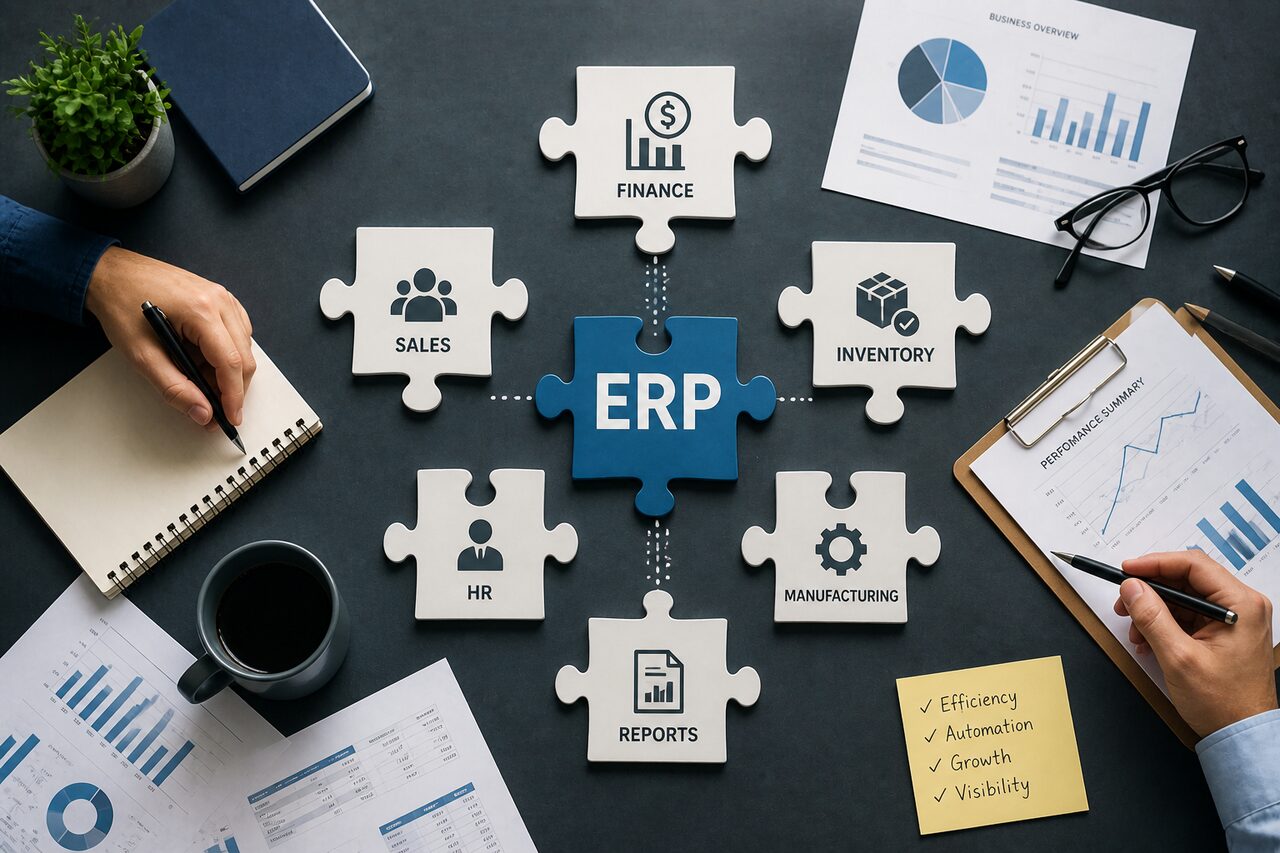
ERP systems are the backbone of modern business operations. They connect your inventory, invoicing, customer relationships, HR, and reporting into a single platform. But here's the problem most businesses run into: they try to force their unique processes into rigid off-the-shelf software. The result is frustration, expensive workarounds, and money spent on features nobody uses.
The Limitations of Off-the-Shelf ERP
Solutions like SAP, Odoo, or Microsoft Dynamics are powerful. They also come with real drawbacks for small and medium enterprises.
Licensing costs are the first shock. Enterprise ERP can run 12,000 to 60,000 EUR per year, with additional fees per user seat. That's before you factor in the customization costs, which frequently run higher than the build cost of a purpose-built solution. Adapting an off-the-shelf ERP to match workflows that weren't designed for it often ends up costing more than starting from scratch.
Then there's vendor lock-in. Once you've committed to a platform and trained your team on it, migrating away is prohibitively expensive. And vendor updates can quietly break your customizations, forcing expensive re-implementation on a schedule you don't control.
The interface complexity problem is underrated. You pay for hundreds of features your team will never use, and the ones they do use get buried under the ones they don't.
Why Custom ERP Built on Laravel Makes Sense
Laravel is the most widely used PHP framework, known for its clean architecture and mature ecosystem. It provides a solid foundation for custom ERP for specific reasons.
Development speed is real. Laravel's built-in Eloquent ORM, job queues, scheduled commands, and notification system dramatically reduce the time to build features that would take months in vanilla PHP. Security defaults are strong out of the box: CSRF protection, SQL injection prevention via parameterized queries, and encryption are all framework-level. The API-first architecture Laravel encourages means integrating with payment gateways, shipping providers, and accounting tools is straightforward rather than a custom hack. And the application can scale horizontally using queue workers (configured via config/queue.php with Redis), caching layers, and load balancers as volume grows.
Real-World Use Cases
Inventory Management
A custom ERP tracks stock across multiple warehouses in real time, automatically generates purchase orders when levels drop below configured thresholds, and provides dashboards showing stock movement trends. Every field, workflow, and notification is built for how your warehouse team actually works, not how a software vendor imagined a generic warehouse works.
Invoicing and Financial Reporting
Generate invoices that comply with your country's specific regulations, automate recurring billing, track payment statuses, and produce financial reports that match your accountant's exact requirements. Not a generic template that needs manual adjustment every month.
Customer Relationship Management
Build a CRM module that mirrors your actual sales process. Track leads through custom pipeline stages, automate follow-up sequences, log every interaction, and generate forecasts based on your historical conversion rates. You can read more about the CRM side of this in our post on how CRM integration reshapes your sales process.
What We Saw on a Latvian Logistics Company Project
A Latvian logistics company was running on a combination of Odoo (for invoicing), a separate Excel-based dispatch tracker, and a third-party warehouse tool that didn't talk to either of them. Staff were spending roughly 2 hours per day reconciling data between systems. We built a custom Laravel ERP over 14 weeks that unified invoicing, dispatch scheduling, driver tracking, and warehouse stock into a single interface. Data reconciliation time dropped to near zero. Invoice generation time (which required 3 manual steps in Odoo) became a one-click action. The total build cost was 28,000 EUR. Their previous Odoo licensing and customization spend had been 18,000 EUR annually.
The ROI Discussion
A custom ERP typically costs between 15,000 and 80,000 EUR to build, depending on complexity. That sounds significant until you compare it to annual licensing fees of 12,000 to 60,000 EUR for enterprise ERP, plus customization costs of 20,000 EUR or more to adapt off-the-shelf solutions to your actual workflows, plus the productivity losses from staff using workarounds daily.
Most businesses recoup the investment within 18 to 24 months through reduced licensing costs, improved operational efficiency, and fewer data errors. The break-even point is often faster than clients expect, because the productivity gains from having a system that actually fits your process tend to compound.
The real question isn't whether a custom ERP is affordable. It's whether your current system is costing you more in hidden inefficiency than a custom build would cost upfront. Our ERP and Laravel Development service starts with a process audit to answer exactly that question before you commit to a build. If you're also thinking about hosting the resulting application, our hosting selection guide covers what infrastructure a Laravel application like this actually needs.