PrestaShop vs WooCommerce: Which Is Right for Your Business?
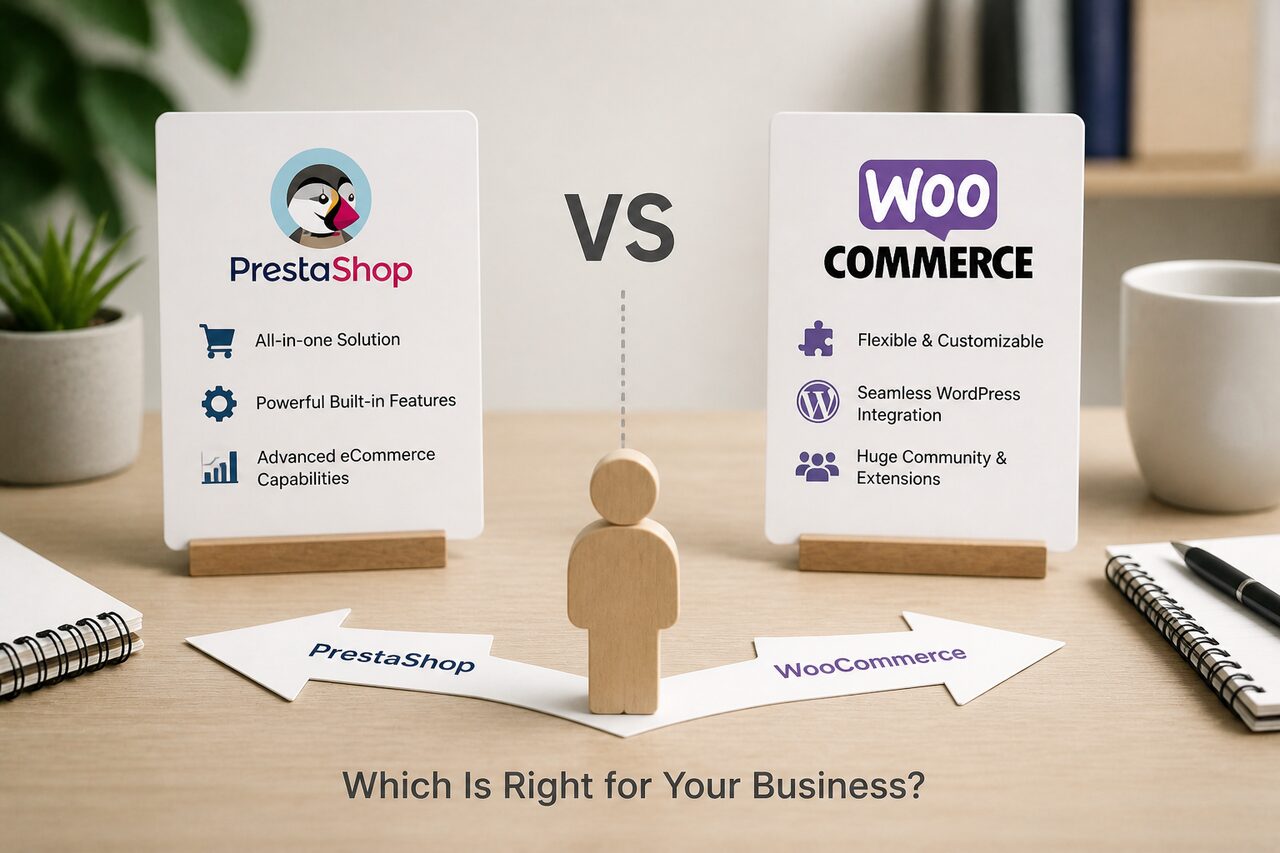
When launching an online store, two platforms dominate the open-source landscape: PrestaShop and WooCommerce. Both are free to start with. Both have large communities behind them. But they serve fundamentally different needs, and choosing the wrong one can cost you months of rework and thousands of euros in migration costs. We've built production stores on both. Here's the honest picture.
Platform Overview
WooCommerce is a plugin for WordPress. It transforms any WordPress installation into a functional online store and inherits WordPress's massive ecosystem of themes, plugins, and content management tools. If content marketing is central to your business, that matters a lot.
PrestaShop is a standalone e-commerce platform built from scratch for online selling. It doesn't depend on another CMS. Its back office is purpose-built for managing products, orders, customers, and inventory, and it shows. The level of granular control over pricing rules, customer groups, and multi-store setups is genuinely impressive once you know your way around it.
Performance and Scalability
For catalogues under 5,000 products, both platforms perform well when properly optimized. Past 10,000 SKUs with complex attribute combinations, PrestaShop holds up better. WooCommerce stores product data as WordPress custom post types, and those wp_postmeta table queries become very slow at scale. A common pattern we see on large WooCommerce installs: a meta lookup running without a composite index, pulling the whole table into a filesort on every category page load.
PrestaShop uses dedicated tables for product attributes and combinations, which makes attribute-heavy catalogue queries significantly faster. That said, WooCommerce with Redis object caching and a well-tuned Nginx FastCGI cache can handle surprisingly large catalogues. The difference becomes pronounced when you add complex filtering, multi-warehouse stock management, or B2B pricing rules.
Cost Comparison
Both platforms are free to download. The real costs are in modules, themes, hosting, and development.
WooCommerce benefits from the WordPress ecosystem. Many plugins are free, and premium extensions typically run between 49 and 199 EUR per year. PrestaShop modules on the official marketplace tend to be pricier, often 79 to 399 EUR, but they're usually more feature-complete. You assemble fewer pieces.
Development costs are more nuanced. WooCommerce custom development is generally cheaper because the PHP developer pool is larger and the WooCommerce action/filter system is well-documented. PrestaShop custom module development requires understanding a more complex override architecture, which narrows the pool of competent developers.
Ease of Use
If your team already knows WordPress, WooCommerce will feel immediately familiar. PrestaShop has a steeper learning curve but rewards you with more granular control. Stock alerts, customer group pricing, carrier restrictions, and multi-store configuration are all native features in PrestaShop that require plugins in WooCommerce.
European Market Considerations
PrestaShop has historically been stronger in European markets. Built-in EU tax rule handling, GDPR-friendly features, and official modules for European payment gateways like Mollie and Adyen are genuine advantages. WooCommerce is catching up. Plugins like Germanized and EU VAT Assistant provide solid coverage, but you're assembling compliance from several pieces rather than getting it natively.
For Latvian and Baltic businesses specifically, we've found PrestaShop 1.7/8 multistore setups work well when a single client operates separate storefronts for different markets, each with its own language, currency, and tax rules. You can read more about GDPR integration in our GDPR compliance checklist.
What We Saw on a Baltic Furniture Retailer Project
A Baltic furniture retailer came to us with a WooCommerce store of roughly 3,200 products across 8 attribute dimensions. Category page load times were averaging 4.2 seconds. We migrated them to PrestaShop 8 with a custom theme, rebuilt the product import pipeline, and added a dedicated combinations cache. Category pages dropped to 1.1 seconds average. Admin order processing time fell by about 40% because the back office was designed for what they were actually doing. Our full PrestaShop Solutions service covers migrations like this end to end.
When to Choose Each Platform
Choose WooCommerce if content marketing and blogging are central to your strategy, if your catalogue is under 5,000 products without complex attribute combinations, if your team already knows WordPress, or if you need maximum design flexibility at the lowest development cost.
Choose PrestaShop if e-commerce is your primary focus rather than content, if you manage a large catalogue with many product variations, if you need B2B pricing rules or multi-store management, or if you operate primarily in EU markets and want compliance features built in rather than bolted on.
There's no universally better platform. The right choice depends on your catalogue size, your team's existing knowledge, and whether your revenue model is more content-driven or pure-commerce. We've built profitable stores on both. Our IT Consulting service includes platform selection as part of the initial assessment, and you might also find our e-commerce speed optimization guide useful regardless of which platform you end up on.